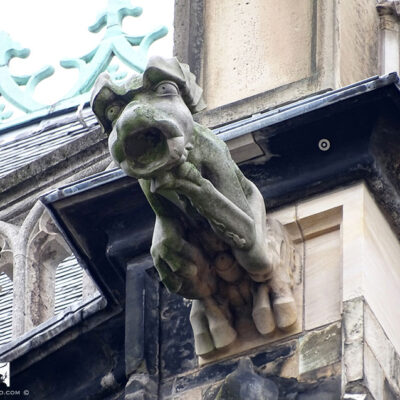
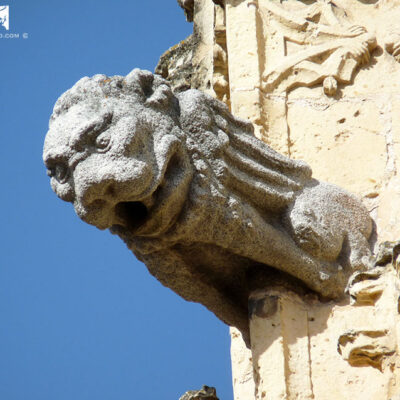
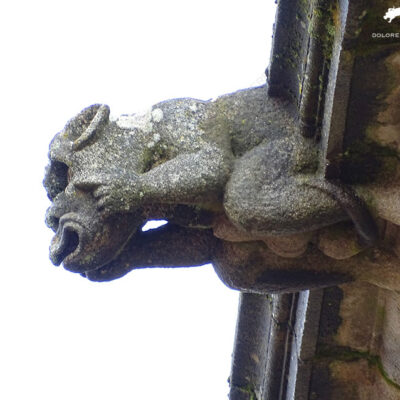
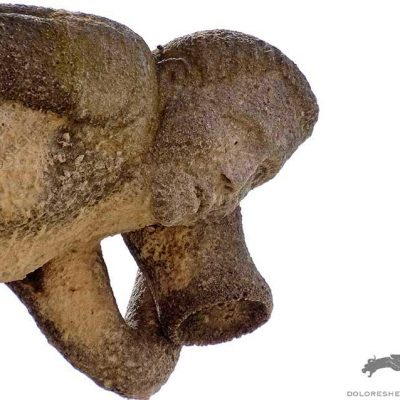
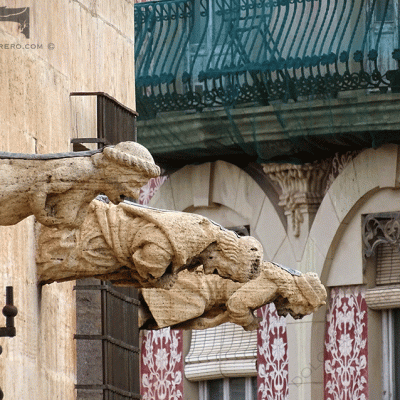
In this entry, we return to Luxembourg to admire the gargoyles of the church regarded as the most important in the country: Notre-Dame Cathedral.
Adjacent to the National Library, the church was built by the Jesuits between 1613 and 1621, and its architecture combines several styles: Gothic, Renaissance, Baroque, and Neo-Gothic. In 1870, it was raised to the rank of cathedral by Pius IX and, between 1935 and 1938, it was enlarged.
Among its architectural features, the slender spires particularly stand out. It is precisely beneath the octagonal balustrade of one of its three tall, slender pinnacles that the eight remarkable metal gargoyles are located, displaying a striking iconography, as presented below.
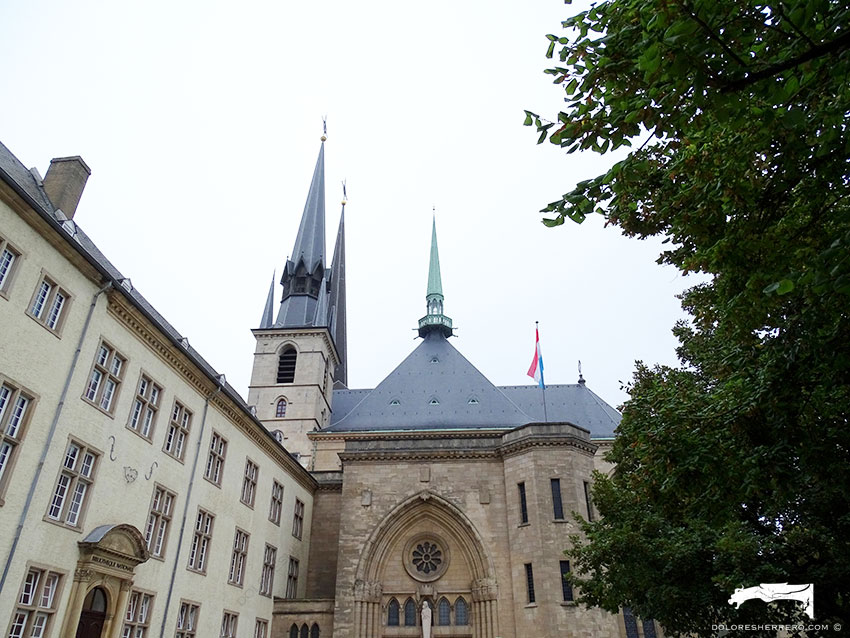
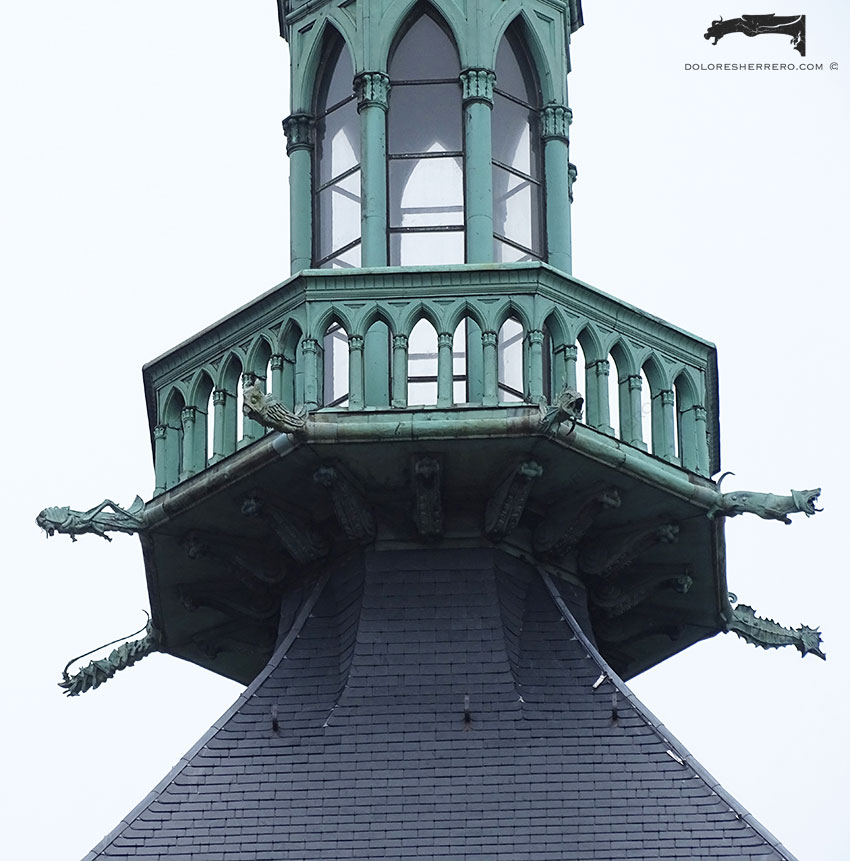
Gargoyles of Notre-Dame Cathedral in Luxembourg
In previous entries, we discussed the representation of unusual animals in gargoyles, animals that are rarely depicted and whose symbolism is particularly interesting. This cathedral stands out in this respect, since, in only eight gargoyles, we find exceptional animals represented.
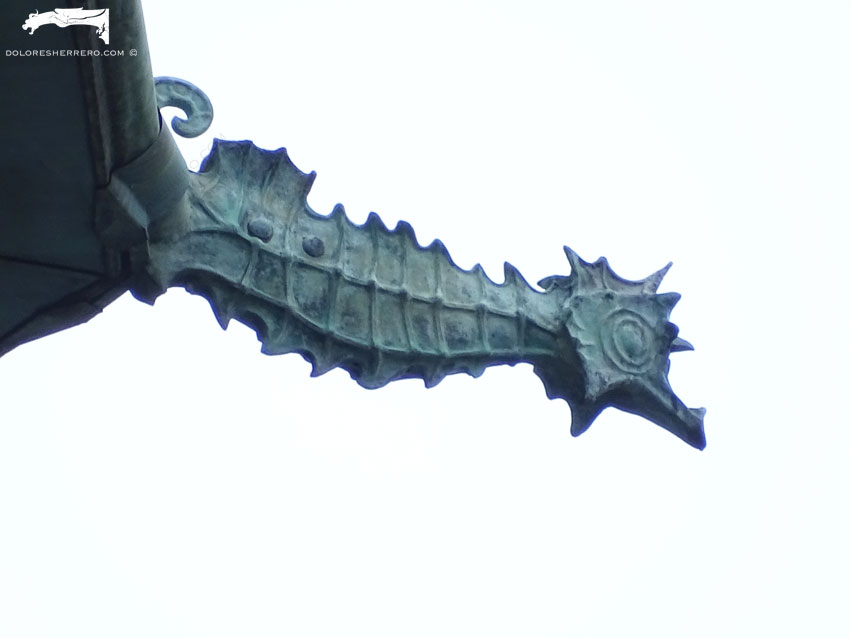
Gargoyle in the Form of a Seahorse
The first gargoyle represents a seahorse, an animal already discussed in a previous entry. Nevertheless, it is worth recalling that Kappler, in his research, notes that in the Greco-Roman world this animal was regarded as a tutelary genius and guide of the dead. It is an animal linked to water, like the sirens which, according to Brunetto Latini, a 13th-century philosopher, are “prostitutes”, malevolent beings “who dwell in water because lust is born of moisture”.
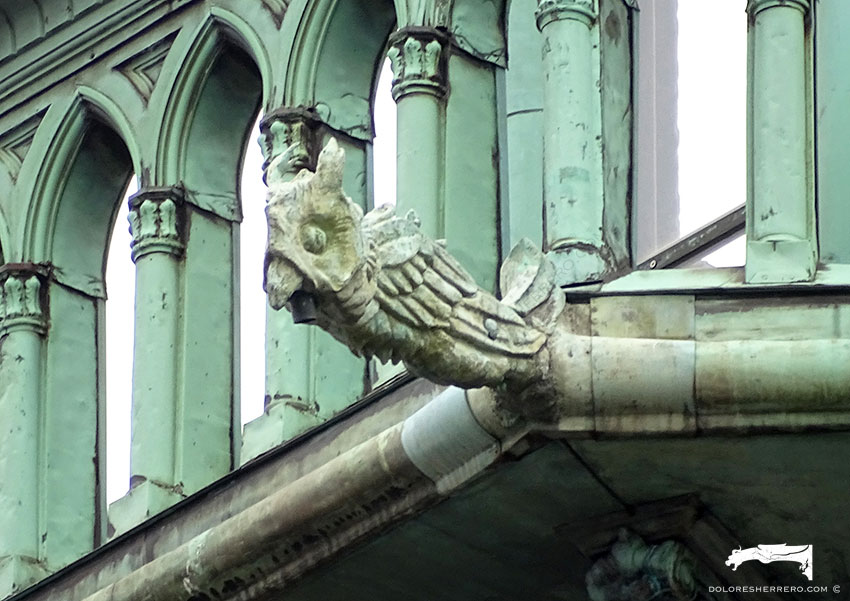
Gargoyle in the Form of a Parrot
The next figure represents a bird of the parrot family. In one of the entries devoted to unusual animals, we also discussed the parrot or popinjay. As noted there, both are under the dominion of Mercury, planet of messengers, intellectuals, and writers. In Covarrubias’s Emblemas morales (1610), the popinjay symbolises the chatterer.
On the parrot, Aristotle (4th century BC) states: “Of the Indian bird, the parrot, it is said that it has a tongue like men. And when it has drunk wine, it becomes, if possible, even more shameless”. Other authors also refer to this animal, such as Saint Isidore (6th–7th centuries), Pliny the Elder (1st century), and Aelian (2nd–3rd centuries). The Tuscan Bestiary (13th century) regards it as a symbol of Christ, since it is a unique animal and the cleanest bird to be found, just as Jesus Christ is unique and conceived without original sin.
Gargoyles in the Form of Insects
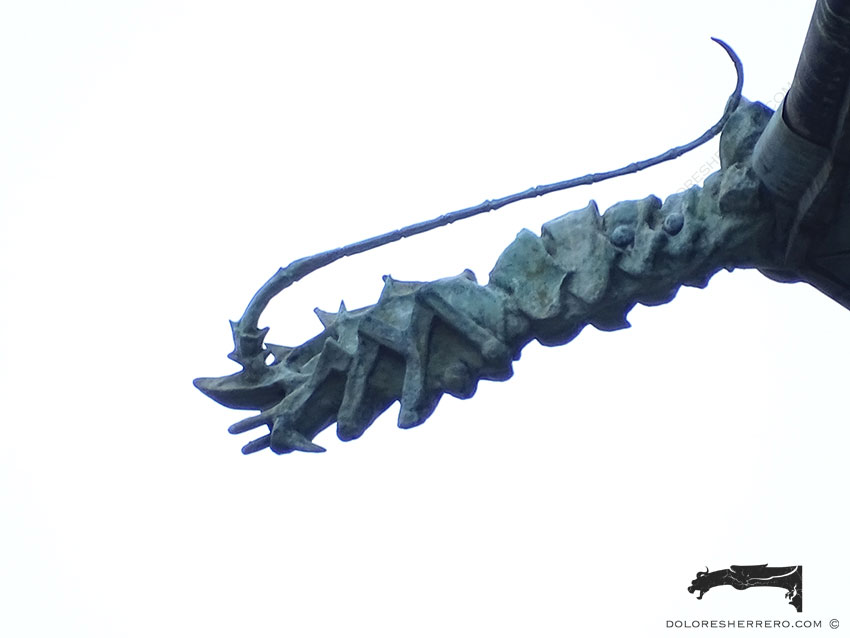
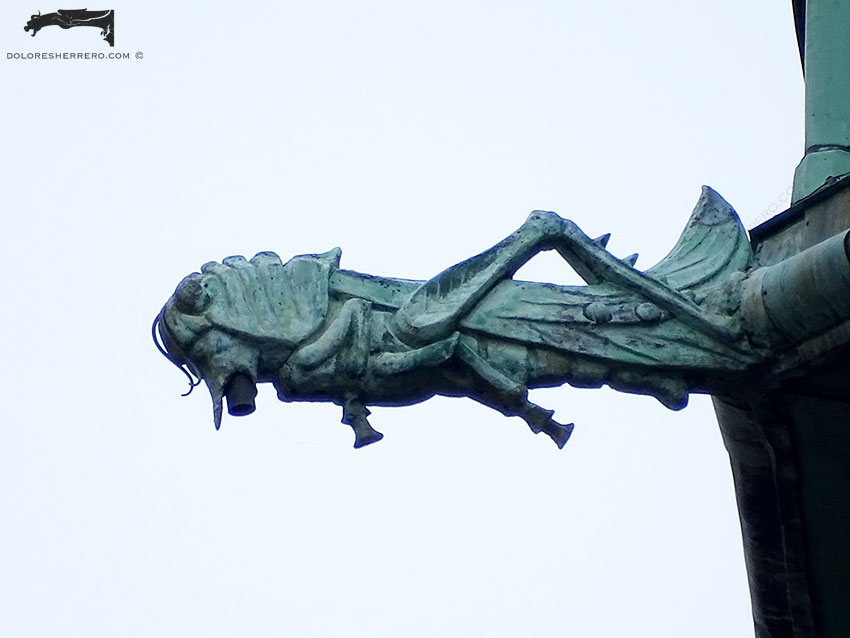
Two atypical and striking gargoyles should also be highlighted. They are two insects, one of them with a long antenna on its head. The other is a locust or grasshopper.
History tells us that the locust has traditionally been an image of devastation and death. In the Bible, it appears among the accursed plagues. In Christian symbolism, it is an emblem of destructive demons and is also identified with heretics. In the Old Testament, it is used as a symbol of smallness. Before God, man is as small as a locust: “He sits above the circle of the earth, and its inhabitants are like grasshoppers” (Isa. 40:22).
In the Book of Revelation, the attack of the locusts upon those who do not bear the seal of God is described: they have the power to torment them for five months, but not to kill them (Rev. 9:4). These small creatures could therefore represent the spiritual torments caused by demons. During the Middle Ages, this insect was considered one of the manifestations of evil and was therefore expelled through conjurations.
Gargoyle in the Form of a Chameleon
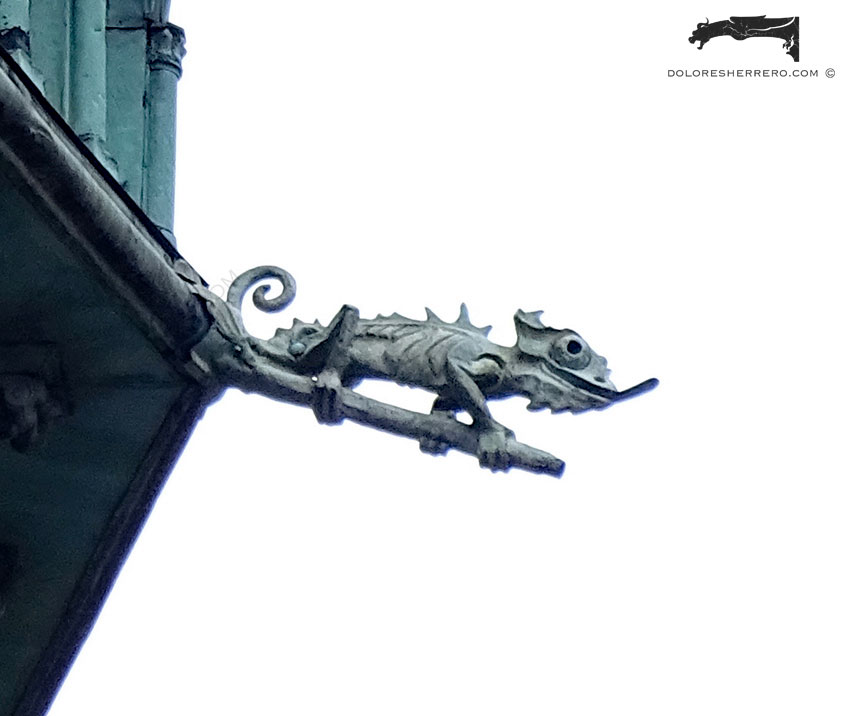
Another animal represented is a chameleon. This curious reptile is said to be under the influence of Mercury. Alciato (16th century), in his Emblem 53, turns it into a symbol of the flatterer because of its ability to change colour according to circumstances.
Pliny states that it is the only animal that feeds on air, neither eating nor drinking. This strange belief also appears in certain bestiaries, such as the Catalan Bestiaries and the Tuscan Bestiary. For this reason, artists chose it as a personified representation of the element air. Since it does not walk on legs like perfect terrestrial animals, Leviticus considers it an impure animal (Lev. 11:30).
Gargoyle in the Form of a Fish
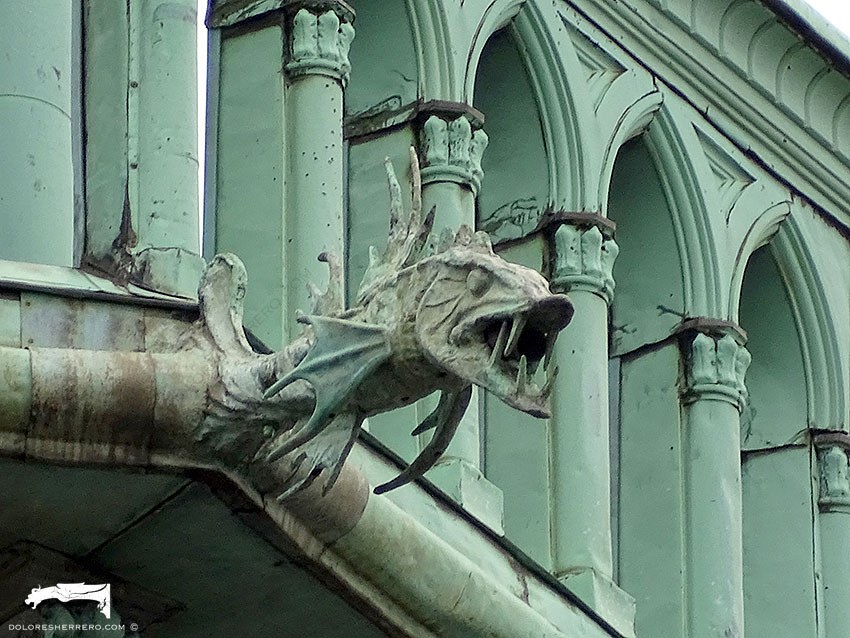
The last unusual animal in the group is a fish with fins resembling wings. Although these wings link it to the flying fish, already mentioned by Aelian, its appearance is closer to that of an abyssal or demon fish, also known as the black devil, with a monstrous aspect.
Gargoyle in the Form of a Dog
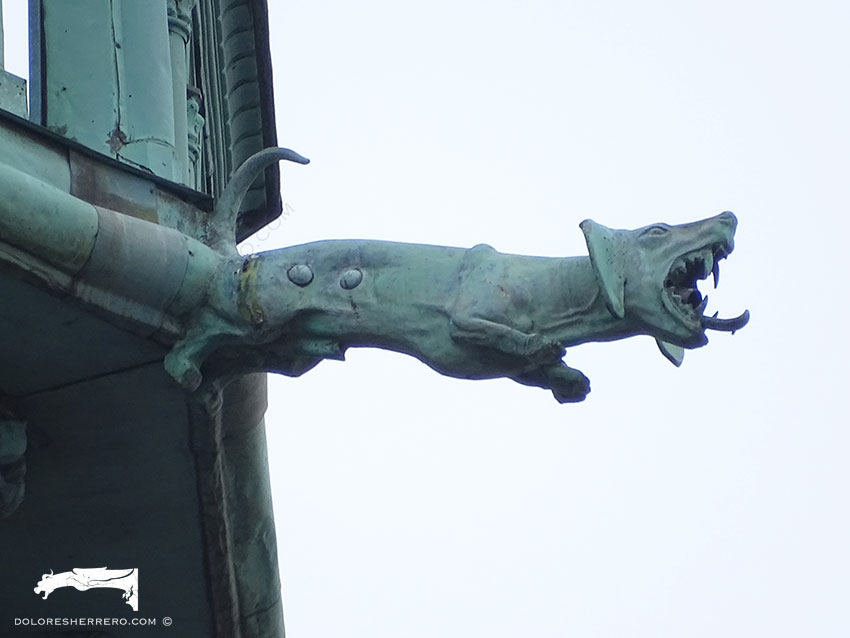
The penultimate gargoyle represents a dog, an animal frequently represented in gargoyles. Although in its positive aspect it is an image of protection and fidelity, in this case it appears aggressive, with large fangs, protruding tongue, and visible genitalia, an image more in keeping with the negative symbolism of the dog (demon, lust, etc.).
Demonic Gargoyle
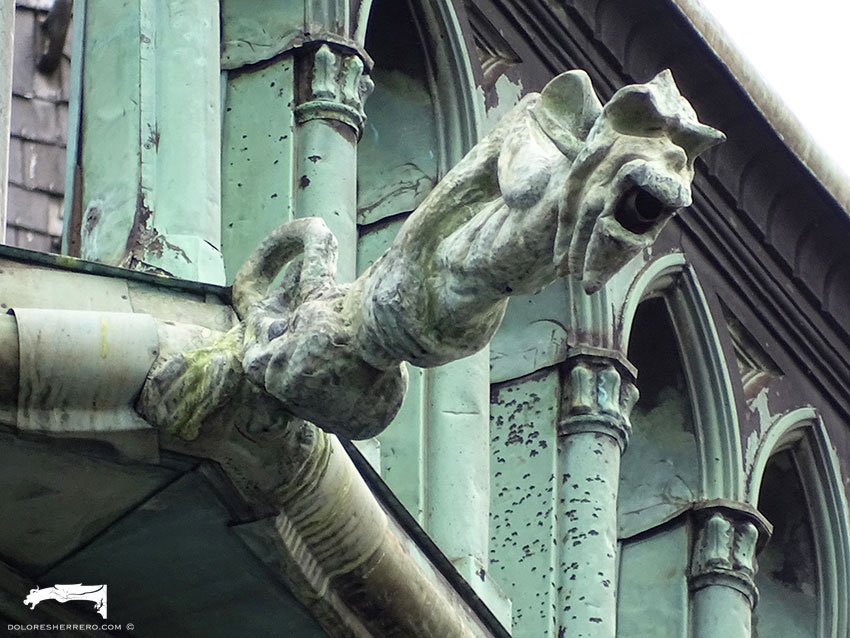
Finally, we find a peculiar demon of terrifying appearance, with a pointed triple chin, frontal horn, large ears, ghostly hollow eye sockets, and a tail emerging behind the body.
A demon and an extraordinary bestiary form this singular ensemble of gargoyles. The quality of the carving and the originality of their iconography make these figures a magnificent example of creativity and symbolic richness within the art of gargoyles.
Bibliography
CHARBONNEAU-LASSAY, L., El bestiario de Cristo. El simbolismo animal en la Antigüedad y la Edad Media, vols. I y II, Palma de Mallorca, José J. de Olañeta, Editor, 1997.
KAPPLER, C., Monstruos, demonios y maravillas a fines de la Edad Media, Madrid, Ediciones Akal, S. A., 1986.
MARIÑO FERRO, X. R., El simbolismo animal. Creencias y significados en la cultura occidental, Madrid, Ediciones Encuentro, 1996.
This entry was originally published in September 2019 and updated in June 2026.
Doctor of Art History and researcher specializing in the study of gargoyles.
I am Dolores Herrero Ferrio, and my thesis, “An Approach to the Study of Gargoyles of Gothic Cathedrals in Castilla and León”, is dedicated to the study of these fascinating figures.
If you like gargoyles and art history, you will also enjoy my book, “The Gargoyle and Its Iconography,” a book I have written with great care for those interested in the world of gargoyles.
I have created my own Encyclopedia of Gargoyles, a Gargopedia to share with you, where you will discover all the secrets and wonders of these enigmatic sculptures.
I hope you enjoy this Gargopedia as much as I have enjoyed creating it, and remember that each gargoyle has a story to tell, and here you will discover them all.