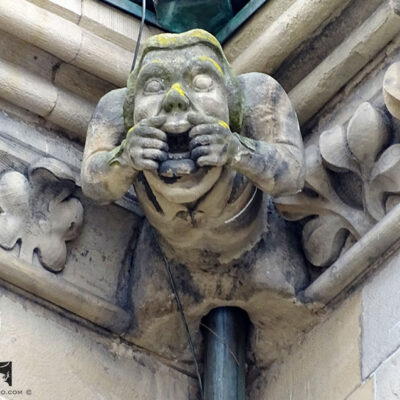
Today we turn to the extraordinary gargoyles of El Burgo de Osma Cathedral, in the province of Soria (Spain). Our attention will focus on four little-known sculptures in the north aisle, of considerable historical and artistic interest.
Although no documentary evidence survives concerning the foundation of the original Romanesque cathedral, its establishment has been associated with Saint Peter of Osma, bishop of the diocese from 1101 to 1109. The Romanesque church was replaced by the Gothic cathedral, construction of which began in 1231 during the episcopate of Juan Díaz, chancellor to Ferdinand III of Castile. The west portal is regarded as an example of the transition from Romanesque to Gothic architecture.
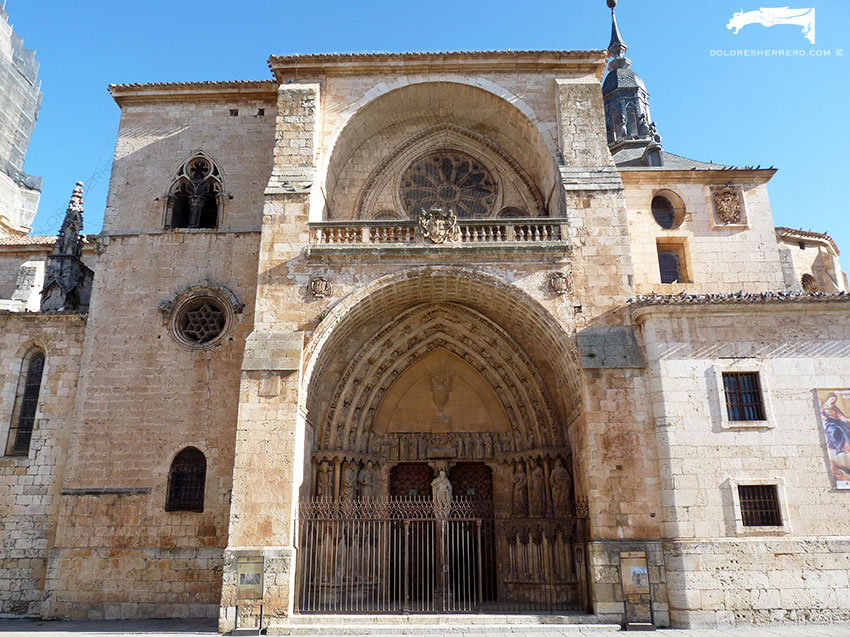
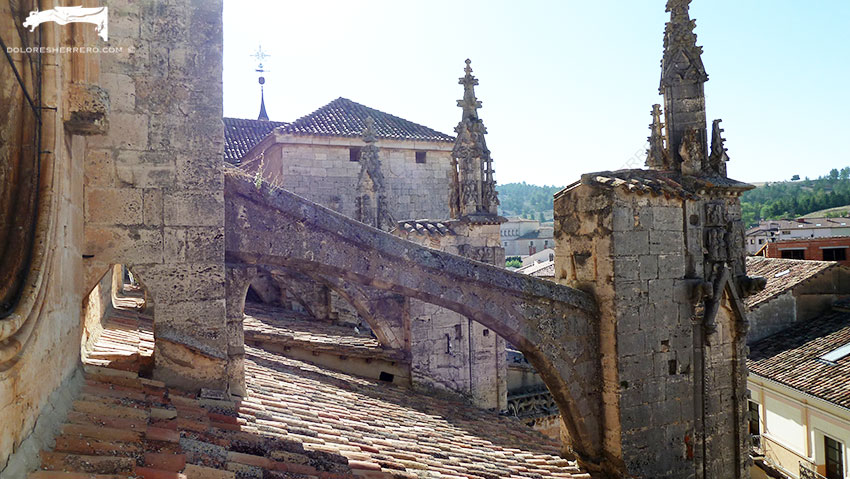
The cathedral is a building of remarkable beauty. From the exterior, we were able to observe several gargoyles, many of which have unfortunately suffered considerable deterioration over time. Nothing, however, prepared us for the extraordinary group we would discover in a concealed part of the building. There remain four gargoyles that we regard as a small survival from the twelfth century: small in number, but of great beauty and historical and artistic value.
These sculptures are located in the north aisle, now concealed from view and adjoining the cloister.
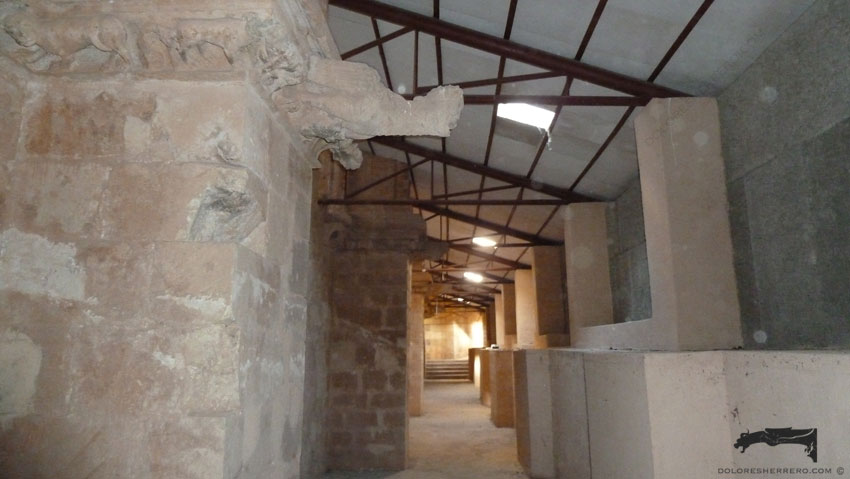
The Four Gargoyles of the North Aisle of El Burgo de Osma Cathedral
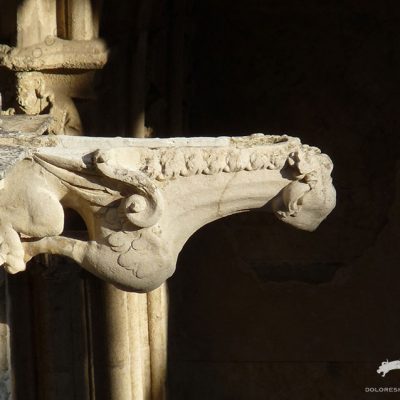
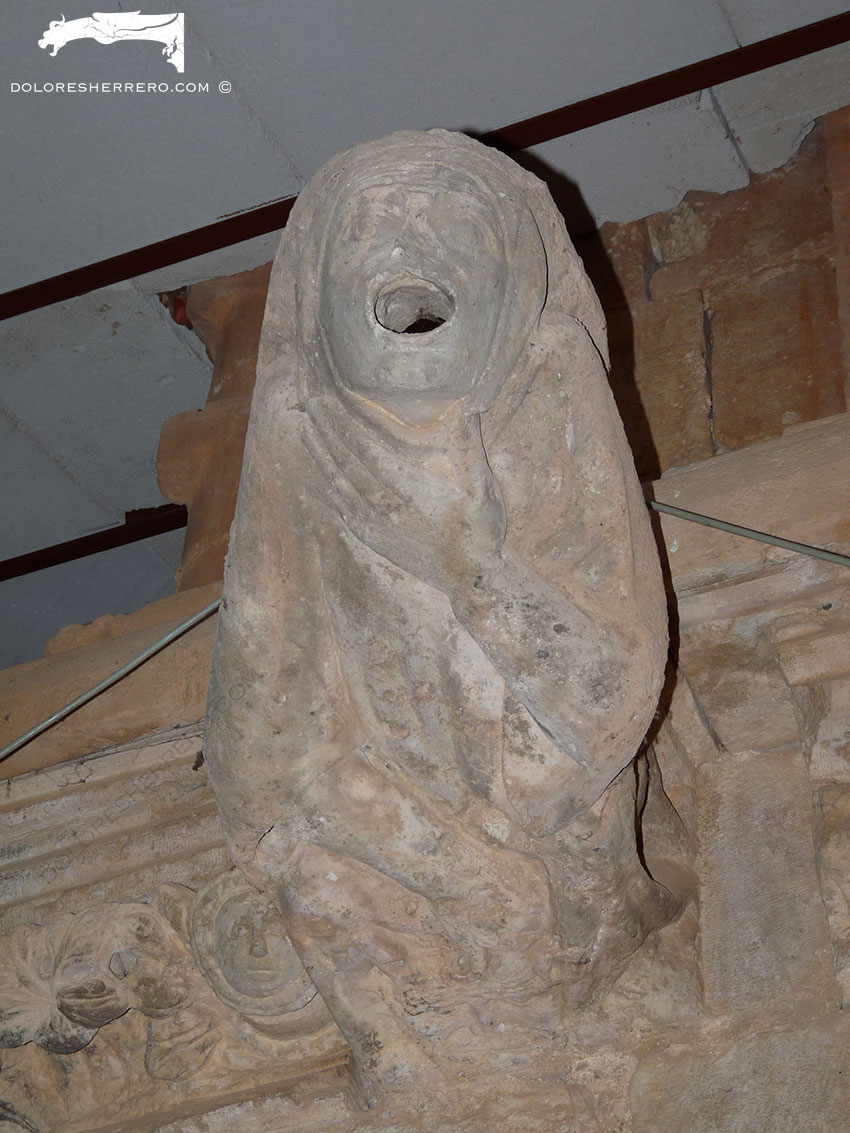
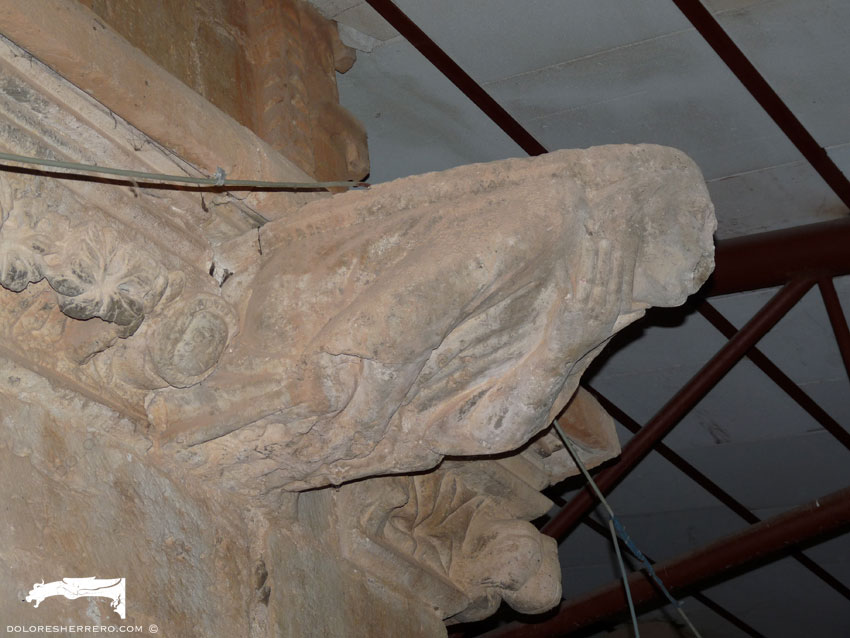
A Female Figure Expressing Suffering
The first gargoyle depicts a woman wearing a mantle. Her highly expressive face, marked by wrinkles on the forehead, appears to convey pain or despair. She raises her left hand to her throat in a gesture that may suggest choking or torment. Janetta Rebold Benton associates this gesture with a warning against the misuse of anything that passes through the throat — food, drink, or words — and also with the apple of Adam and Eve, recalling Original Sin and the Fall.
With her right hand, she grasps what appears to be a horn projecting from the upper part of a human head, itself expressive and marked by wrinkles on the forehead. The figure may represent a female sinner lamenting her transgressions. A closely comparable representation appears on a gargoyle at Bordeaux Cathedral.
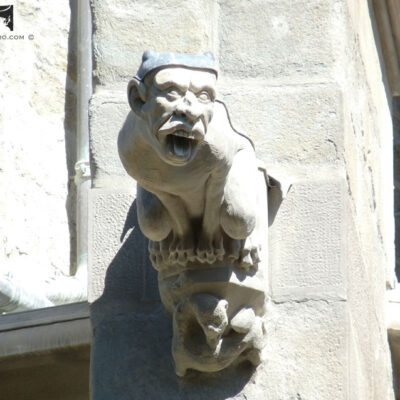
An Anthropomorphic Figure Holding a Lamb
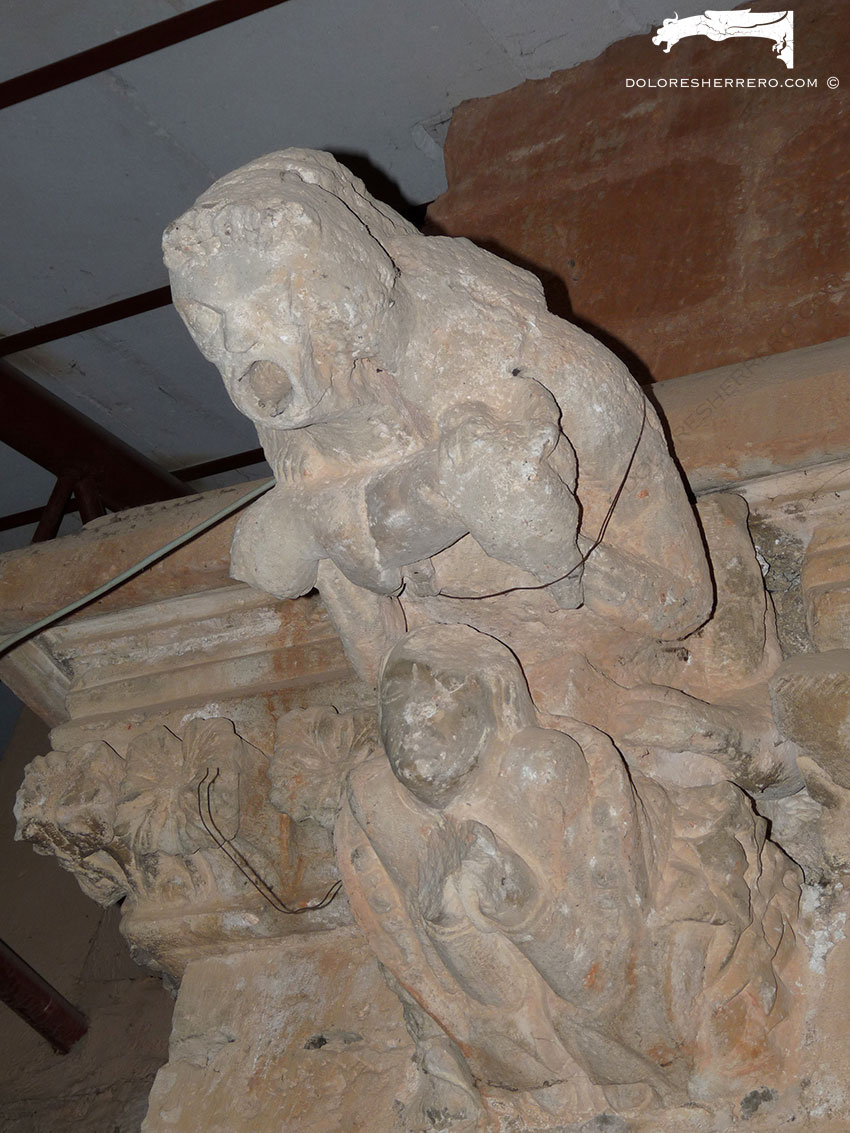
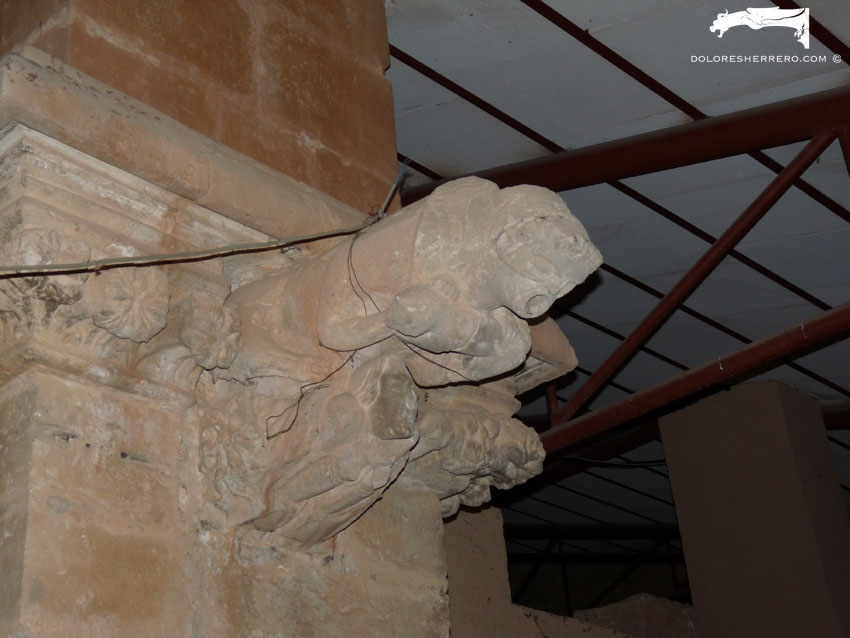
The next gargoyle has the torso, arms, and head of a human figure, while animal legs project from behind and beneath it. The figure has curly hair and wears a short medieval cloak. Its face is expressive, and it appears to be screaming. With both hands, it holds a small quadruped resembling a lamb. The lamb symbolises Christ, who willingly offered himself in sacrifice to redeem humanity.
Below is a male figure whose hands appear to be joined in prayer or supplication, perhaps a sinner, and who may be emerging from a large, toothed mouth, possibly that of a demon. Although its typological identification is not straightforward, the principal figure appears to be an anthropomorphic creature with animal hind legs, holding a lamb and positioned above a praying figure.
As in the preceding gargoyle, the composition may allude to sin and the confrontation between good and evil: the lamb, associated with Christ, is contrasted with the monstrous mouth or the possibly demonic anthropomorphic figure.
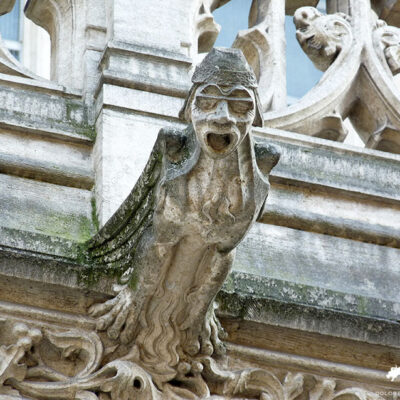
An Anthropomorphic Figure with the Body of an Eagle
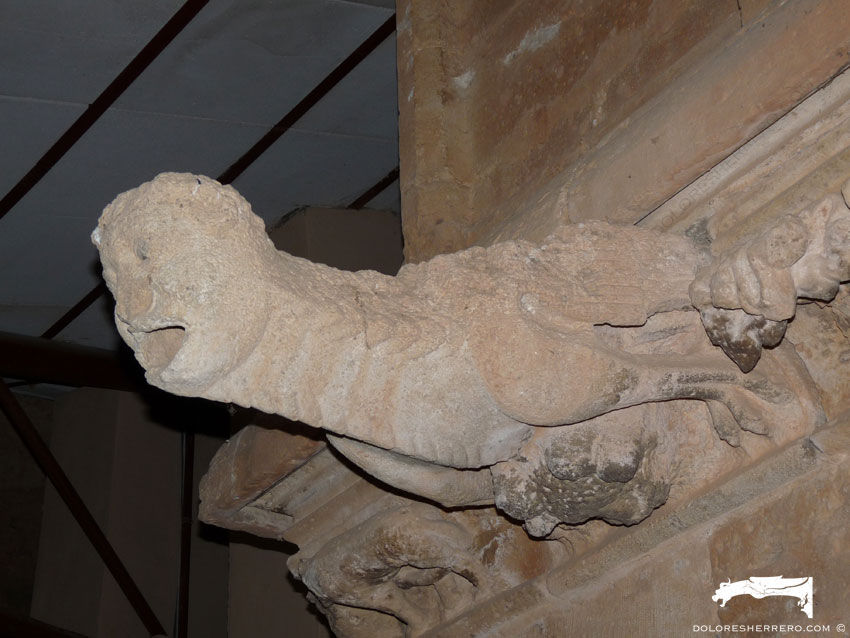
The third gargoyle depicts an anthropomorphic creature with the body of an eagle and a human head with curly hair. The dragon-like texture of the skin on its neck and its prominent windpipe lend it a demonic character. Beneath it is another head, which may represent a ram, judging by its curly fleece and horns. Figures holding lambs or rams also occur in other forms of medieval art, including thirteenth-century bestiaries and sculpted capitals.
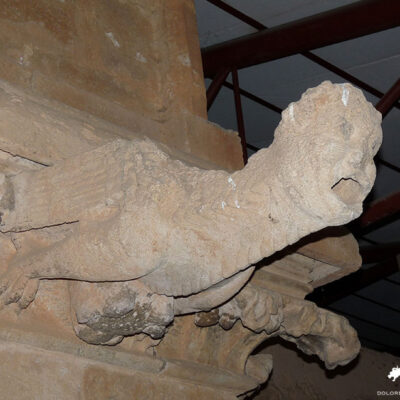
A Damaged Gargoyle of Indeterminate Type
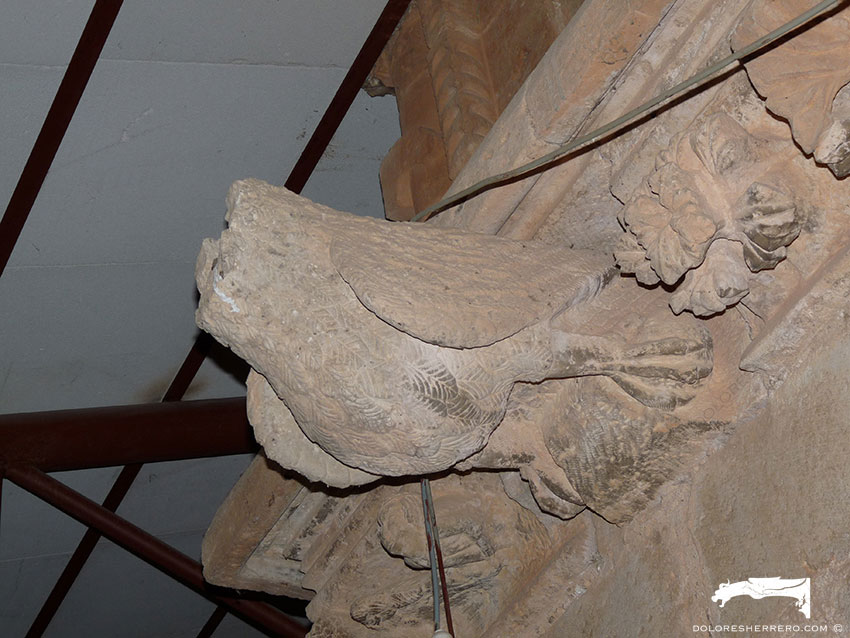
The final gargoyle is of indeterminate type owing to the loss of its head. It has the body of an eagle, and between its legs there is what was probably another head, although the severe erosion of the stone prevents its identification. In its left talon, it holds a rounded element whose nature likewise cannot be established because of the deterioration.
The Artistic and Iconographic Significance of the Ensemble
These four magnificent and highly expressive gargoyles may contain allusions to sin and to the confrontation between good and evil. Art and history converge in these extraordinary sculptures. Their singularity, the quality of their carving, and the richness of their subject matter make them particularly significant examples of the artistic heritage of Castile and León.
Bibliography
ARRANZ ARRANZ, J., La Catedral de Burgo de Osma (Soria). Guía turística, Ilmo. Cabildo de la S. I. Catedral, 1981.
MARIÑO FERRO, X. R., El simbolismo animal. Creencias y significados en la cultura occidental, Madrid, Ediciones Encuentro, 1996.
MARTÍNEZ FRÍAS, J. M., El Gótico en Soria. Arquitectura y escultura monumental, Salamanca, Ediciones Universidad de Salamanca. Publicaciones de la Excma. Diputación Provincial de Soria, 1980.
PALACIOS, F. y FRÍAS BALSA, J. V., Burgo de Osma y sus monumentos, Ingrabel-Almazan, 1975.
REBOLD BENTON, J., Holy Terrors. Gargoyles on medieval buildings, New York, Abbeville Press, 1997.
TARACENA, B. y TUDELA, J., Guía artística de Soria y su provincia, Soria, Diputación Provincial de Soria, 1997.
This entry was originally published in October 2020 and updated in October 2026.
Doctor of Art History and researcher specializing in the study of gargoyles.
I am Dolores Herrero Ferrio, and my thesis, “An Approach to the Study of Gargoyles of Gothic Cathedrals in Castilla and León”, is dedicated to the study of these fascinating figures.
If you like gargoyles and art history, you will also enjoy my book, “The Gargoyle and Its Iconography,” a book I have written with great care for those interested in the world of gargoyles.
I have created my own Encyclopedia of Gargoyles, a Gargopedia to share with you, where you will discover all the secrets and wonders of these enigmatic sculptures.
I hope you enjoy this Gargopedia as much as I have enjoyed creating it, and remember that each gargoyle has a story to tell, and here you will discover them all.